

Unveiling the Best AI Tools for Investors: A Comparative Guide
Explore the top AI-powered platforms and apps for smarter investment decisions.
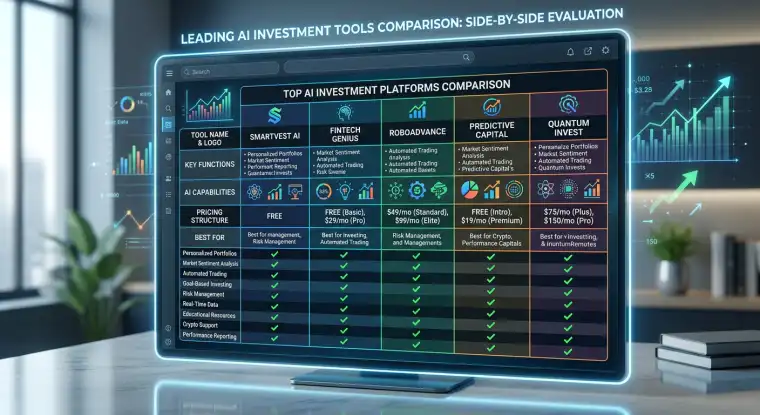
Are you ready to change your investment strategy? Artificial intelligence has created many tools to help investors manage the market's complexities.
AI analyzes large data sets and predicts market trends. It is changing how we make financial decisions. But, how do you choose the right tool?
This guide compares some of the best AI tools for investors. It focuses on their features, benefits, and how well they suit different investment styles.
In investing, staying ahead is critical. AI tools offer an advantage by automating tasks and providing data-driven insights. They can help find opportunities that traditional methods might miss. This article explores some of the leading AI tools available. It compares their features, strengths, and potential problems. This guide will help you understand how AI can improve your investment strategy, whether you are a seasoned investor or just starting.
Quick navigation
What this means for you
Using AI tools can improve your investment results. These tools offer several advantages, including:
- Enhanced Analysis: AI can process and analyze vast amounts of data quicker and more efficiently than people. This allows for in-depth analysis of market trends, company finances, and economic indicators.
- Improved Decision-Making: AI tools provide data-driven insights and predictions. This helps investors make better decisions, reducing the need to rely on intuition or guessing.
- Time Savings: Automating research and analysis tasks saves time. This allows investors to focus on strategic planning and portfolio management.
- Risk Management: AI can find risks and opportunities. This helps investors manage their portfolios more effectively and reduce losses.
- Personalized Insights: Many AI tools offer custom recommendations and insights based on individual investment goals and risk tolerance.
Remember that AI tools do not replace human judgment. Use them to support, not replace, your analysis and understanding of the market. Consider how these tools can fit into your investment process to get the most benefit.
AI Tools for Financial Analysis: An Overview
AI tools in finance use machine learning, natural language processing (NLP), and predictive analytics to provide various services. These tools range from basic data analysis and stock screening to complex portfolio optimization and risk assessment. Some key applications include:
- Stock Market Analysis: AI algorithms can analyze financial statements, news articles, social media, and other data to predict stock prices and find investment opportunities.
- Portfolio Management: AI can optimize portfolios by analyzing risk factors, asset correlations, and market trends. This helps investors achieve their financial goals.
- Risk Assessment: AI-powered tools can assess market volatility and find potential risks. They help investors make better decisions about asset allocation and risk management.
- Algorithmic Trading: Many AI tools automate trading strategies based on rules and market conditions. This gives investors a hands-off approach to trading.
- Sentiment Analysis: NLP techniques analyze news articles, social media, and other text-based data to gauge market sentiment and find investment opportunities.
These applications give investors tools to make better decisions and improve their investment results. But how do you choose the right tool?
Key Features to Look For
When evaluating AI tools for investing, consider these features:
- Data Sources: Does the tool provide access to reliable data sources? These include financial statements, market data, economic indicators, and news feeds.
- Analytics Capabilities: Does the tool offer strong analytics capabilities? Examples are financial modeling, predictive analysis, and risk assessment.
- User Interface: Is the user interface easy to use? Does the tool show data and analysis clearly?
- Customization Options: Does the tool let you customize your investment strategy, set up alerts, and tailor the analysis to your needs?
- Integration: Does the tool work with your existing investment platforms and brokerage accounts?
- Accuracy and Reliability: Does the tool provide accurate and reliable insights? Consider the tool's history and the quality of its data sources.
- Cost: How much does the tool cost? Does it offer a free trial or a free version with limited features? Does the cost match the value?
Considering these features helps you choose the AI tools that best fit your investment style and goals.
Top AI Tools for Investors: A Comparison
Let's look at some leading AI tools, comparing their features, strengths, and potential problems:
1. Kensho (S&P Global):
Kensho is a tool that helps investors analyze large amounts of financial data and generate insights. Kensho's main strength is its ability to answer complex financial questions and quickly process large data sets. It uses machine learning and natural language processing to get information from news articles, financial reports, and other sources.
Key Features:
- Natural Language Processing (NLP) for answering complex financial questions
- Data analysis across various financial data sources
- Integration with S&P Global's extensive data resources
Pros: Powerful analytical capabilities, access to extensive data, user-friendly interface.
Cons: Primarily for institutional investors, can be costly.
2. Sentieo:
Sentieo is a financial research platform that uses AI to provide insights into company fundamentals, market trends, and industry analysis. It helps investors analyze financial statements, presentations, and other data to find investment opportunities and manage risks. Sentieo is useful for fundamental research.
Key Features:
- Financial statement analysis tools
- Market and industry research capabilities
- Customizable dashboards and alerts
Pros: Comprehensive financial data and analysis tools, user-friendly interface, robust reporting capabilities.
Cons: Subscription fees can be high, requires some financial analysis expertise.
3. TrendSpider:
TrendSpider focuses on technical analysis, using AI to automate chart analysis and trend identification. It scans charts for patterns and finds support and resistance levels. It also provides automated alerts. TrendSpider is a valuable tool for traders and investors who use technical analysis.
Key Features:
- Automated chart analysis
- Pattern recognition
- Alerts for price movements and trend changes
Pros: Powerful technical analysis tools, automated chart analysis, real-time alerts.
Cons: Primarily focused on technical analysis, less emphasis on fundamental data.
4. TradingView:
TradingView is a platform for technical and fundamental analysis. It offers tools for traders and investors. TradingView provides charting capabilities, screeners, and market data. It uses AI to provide insights and recommendations. It also has a community of traders and investors who share their ideas and analysis.
Key Features:
- Advanced charting tools
- Stock and crypto screeners
- Community-driven analysis and ideas
Pros: Comprehensive charting tools, user-friendly interface, free and paid options.
Cons: Some advanced features require a paid subscription, less emphasis on AI-driven insights compared to dedicated AI tools.
5. FinBrain Technologies:
FinBrain offers AI-powered tools for investment insights and recommendations. The platform uses AI to analyze financial data, predict market trends, and find investment opportunities. FinBrain offers stock screeners, portfolio optimizers, and market sentiment analysis.
Key Features:
- Stock screening and analysis
- Portfolio optimization tools
- Market sentiment analysis
Pros: Wide range of AI-powered investment tools, user-friendly interface, free and paid options.
Cons: Limited historical data, analysis may not be as in-depth as some other tools.
Risks, trade-offs, and blind spots
While AI tools offer benefits, be aware of these potential risks and limitations:
- Data Bias: AI models are trained on data. If that data is biased, the AI will likely repeat those biases. It's important to know the tool's data sources and evaluate the insights it provides.
- Over-Reliance: Relying too much on AI tools can lead to a lack of critical thinking. Always check the results with your research.
- Lack of Transparency: Many AI tools are "black boxes." It can be hard to understand how the AI reached its conclusions. Be careful with tools that don't explain their methods.
- Market Volatility: AI tools are trained on historical data. Their ability to predict may be limited in volatile or unusual market conditions.
- Security Concerns: Ensure the AI tool has security measures to protect your financial data.
How can investors reduce these risks and make informed decisions?
Main points
AI tools offer powerful capabilities for investors. Here is a summary of the key takeaways:
- Enhanced Analysis: AI can analyze vast amounts of data to provide in-depth insights into market trends and company finances.
- Improved Decision-Making: AI tools help investors make more informed decisions by providing data-driven insights and predictions.
- Time Savings: Automating research and analysis tasks frees up time for strategic planning and portfolio management.
- Diverse Options: Various AI tools cater to different investment styles, from technical analysis to fundamental research.
- Careful Evaluation: Choose AI tools based on your needs. Consider factors like data sources, analytics capabilities, and cost.
- Be Critical: Always check AI-generated insights with your research and analysis.
- Stay Informed: Keep up with the latest developments in AI and financial technology to improve your investment strategies.
Use AI tools to improve your investment strategy. Always remember to use them with your critical thinking and financial expertise. Investing involves risks. However, you can make better decisions and achieve your goals with the right tools and approach.